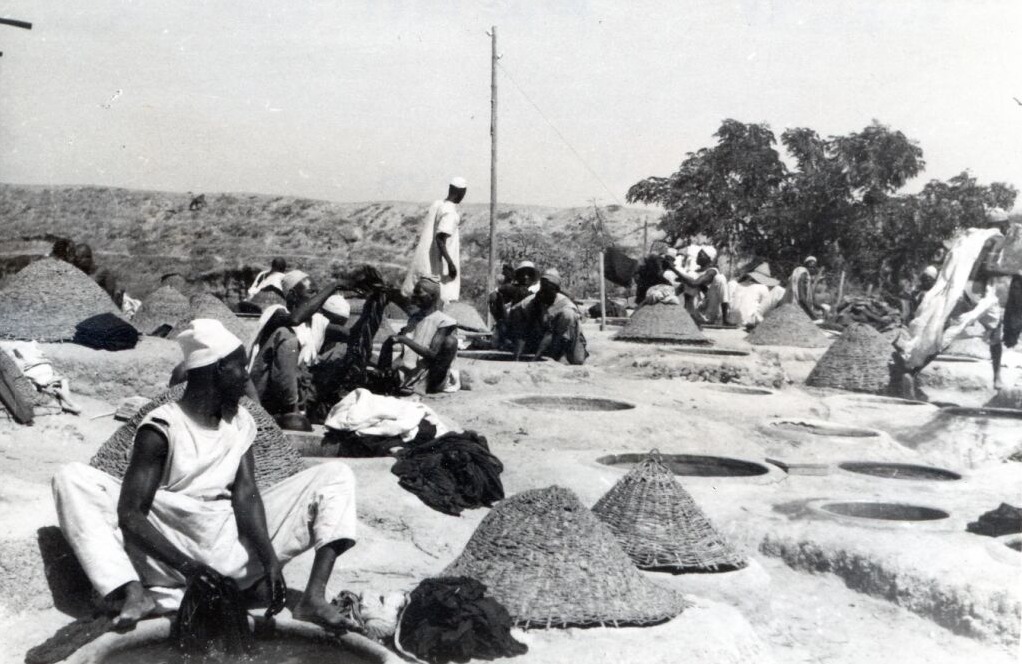
The dye pits
There is a date painted above a gate in Kano: 1498. Behind it are the dye pits, which have been in the same family ever since. What is closing them is not neglect. It is the price of a yard of cloth.
A group of workers at the Kano Dye Pits, Nigeria, 1951. Silver gelatin print by an unknown photographer. Original held in the Archives Centre, National Museums Liverpool, John Holt Collection, B/JH/PHO/470. Reproduced with permission. The caption on the reverse reads: “the pits are about 12 feet deep”.
Somebody painted the date on the wall.
Above the entrance to the dyeing ground at Kofar Mata, in letters that need repainting, is a year. 1498. It is not on a plaque and it is not behind glass. It is on the arch, over a gate people walk through to get to work.
The claim behind it is specific rather than vague: . His descendants still run the place, and it is the seventh generation of them who answer the phone.
Most heritage dates arrive from a government body or a tourist board. This one arrives from the family, and it has been on the wall long enough to need repainting.
Indigo, ash, and a month of waiting.
A dye pit is not a bucket. — we know that because somebody wrote it on the back of a photograph in 1951, and the photograph is at the top of this page.
. Then it waits: . Cloth goes in for hours, not minutes, and is lifted out periodically to drip, because the chemistry needs air as much as it needs time.
Everything about the process is slow on purpose. That is the whole of the economics of this piece, stated early.
This was not a workshop. It was a sector.
It is easy to read Kofar Mata as a surviving craft. For most of its history it was closer to a works. .
Kano sat where the desert routes met the savannah, and the thing it sold was finish. Cotton could be grown in a lot of places. A deep, even, fast blue that did not wash out was harder, and the city that could do it reliably could charge for it.
The month of fermentation was never the inefficiency. It was the barrier to entry. Anybody could sell cloth. Not everybody could sell that colour.
The slowness was not a weakness in the business. For five hundred years it was the business.
A hundred and forty-four pits. Five working.
In 2020 the association gave a number: . In 2023, .
Two counts, three years apart, from the same people. That is not a trend line, but it is a direction, and it is the closest thing to a measurement anyone has published.
A wire report from 2007 describes thirteen pit complexes across Kano and more than a hundred pits fallen into disrepair. The association describes a hundred and forty-four pits at this one site. Those two things can both be true, or one of them can be counting something different, and we cannot tell you which.
There is no published condition survey of Kofar Mata that we have been able to find. We have asked. If one exists we will publish the number; if it does not, then the oldest working industrial site in the country is being counted by the men who work in it, from memory, for journalists who visit every few years.
Nobody closed the pits. They were outbid.
The reasons the dyers give are not about heritage. They are about cost. . On the input side, , so the cloth to be dyed got more expensive at the same time as the finished competition got cheaper.
, which squeezes the last part of the process they still control.
Read in order, those three facts describe an ordinary commercial failure rather than a cultural one. A producer whose cost is time, competing against a producer whose cost is nothing, in a market where the buyer cannot see the difference until the colour fades.
The dye takes a month to come up. The cloth it loses the sale to is printed in a day and sells for about half the price. That is the entire mechanism. Kofar Mata is not being neglected to death; it is being outbid, one yard at a time, by a product that does not have to wait.
The gate still says 1498. Five pits are still warm. Whether that is survival or the last of it is a question nobody has the figures to answer, which is the reason this page exists.
You pass this gate in Kano.
Thirty-eight seconds. Hidden in Plain Sight, from the Kano chapter.
Read the filmEvery word on screen, in order.
You pass this gate in Kano,
but never look at what grew inside it.
This is Kofar Mata,
one of the gates in Kano’s ancient city wall,
and just inside it are Kano’s famous indigo dye pits.
Pits established 1498.
For centuries, craft helped make Kano famous for its dyed textiles.
The wall protected the city,
just inside it, part of history was made blue.
Made and paid for by Sponge Media. No sponsor on this film or this page.
Get the next one before anyone else.
One email when a new piece goes up. The working, the sources, and what we couldn't stand up. No more than that.
Subscribe on SubstackFree. Unsubscribe any time. We don't sell or share the list.
Where all of this came from
Every claim in the piece, with its source and its status. Nothing hidden in a footnote, including the things we haven't nailed down yet.
"We've run Kofar Mata dye pit for 522 years" — Dabosa family. Reported by Ibrahim Musa Giginyu in Kano, with Malam Haruna Baffa, a seventh-generation descendant of the founder and secretary of the Kofar Mata association, as the named source.
https://dailytrust.com/weve-run-kofar-mata-dye-pit-for-522-years-dabosa-family/ ↗
Caption written on the reverse of the 1951 silver gelatin print B/JH/PHO/470: "the pits are about 12 feet deep". Archives Centre, John Holt Collection. Supplied to Sponge Media by the curator of photographic collections.
https://www.liverpoolmuseums.org.uk/archives ↗
"A little indigo, a handful of ash and time" — AP photo essay from Kofar Mata; "a dash of potassium holds the color in". The dyers interviewed state that the pits use no chemicals.
https://www.foxnews.com/world/indigo-ash-and-time-mark-nigerias-centuries-old-dye-pits ↗
"The preparation of the indigo dye takes up to a pungent month." Cloth is then soaked for up to several hours for the darkest shades, lifted periodically to drip because the process needs air.
https://www.foxnews.com/world/indigo-ash-and-time-mark-nigerias-centuries-old-dye-pits ↗
"Ancient indigo dye pits barely survive in Nigeria", filed from Kano. The report also describes more than a hundred pits fallen into disrepair, and quotes the chief dyer Hamidan Uba Zango, then 80, who had worked the pits since he was six.
https://www.historynewsnetwork.org/article/ancient-indigo-dye-pits-barely-survive-in-nigeria ↗
Malam Haruna Baffa, secretary of the Kofar Mata association, quoted directly: "out of the 144 pits used as dye pits in the centre, only 10 are presently functional."
https://dailytrust.com/weve-run-kofar-mata-dye-pit-for-522-years-dabosa-family/ ↗
"However, not more than five are now functional, just to keep the business going." Reported from Kano with Haruna Baffa and Ibrahim Hamisu of the Kofar Mata Dyeing Centre as sources.
https://dailytrust.com/dyeing-business-dying-as-525-year-old-kano-pit-faces-extinction/ ↗
Craftsmen at Kofar Mata told AP that Chinese fabrics sell for about half the price and fade quickly. Ibrahim Ahmed Ibrahim asked the president for tariffs on imported textiles: "Better our own."
https://www.foxnews.com/world/indigo-ash-and-time-mark-nigerias-centuries-old-dye-pits ↗
Haruna Baffa, secretary of the Kofar Mata dyeing centre: "We used to buy one yard at N400, but it is now N700." The same report cites the naira redesign period and insecurity in the north as pressures on the trade.
https://dailytrust.com/dyeing-business-dying-as-525-year-old-kano-pit-faces-extinction/ ↗
"Conservation of Intangible Cultural Heritage of Dyeing Skills: Challenges and Strategy in Kofar Mata Dyeing Pits Industry, Kano Nigeria." Six working dyers interviewed as key informants. The paper records that natural indigo is becoming scarce and that younger workers prefer synthetic dye as faster and easier.
https://hrmars.com/papers_submitted/11943/conservation-of-intangible-cultural-heritage-of-dyeing-skills-challenges-and-strategy-in-kofar-mata-dyeing-pits-industry-kano-nigeria.pdf ↗
Reporting
Sponge Media
Editorial direction
Dayo Elegbe
Design and build
Sponge Media
Funding
Sponge Media. No sponsor.
Corrections and changes
- 13 Oct 2026 — First published.