Twenty camel-loads of silver
A Nigerian refinery supplied about a fifth of Europe's jet fuel in a single month. The family that owns it made its first fortune on groundnuts, buying at a price fixed in an office. What changed between the two is not the commodity.
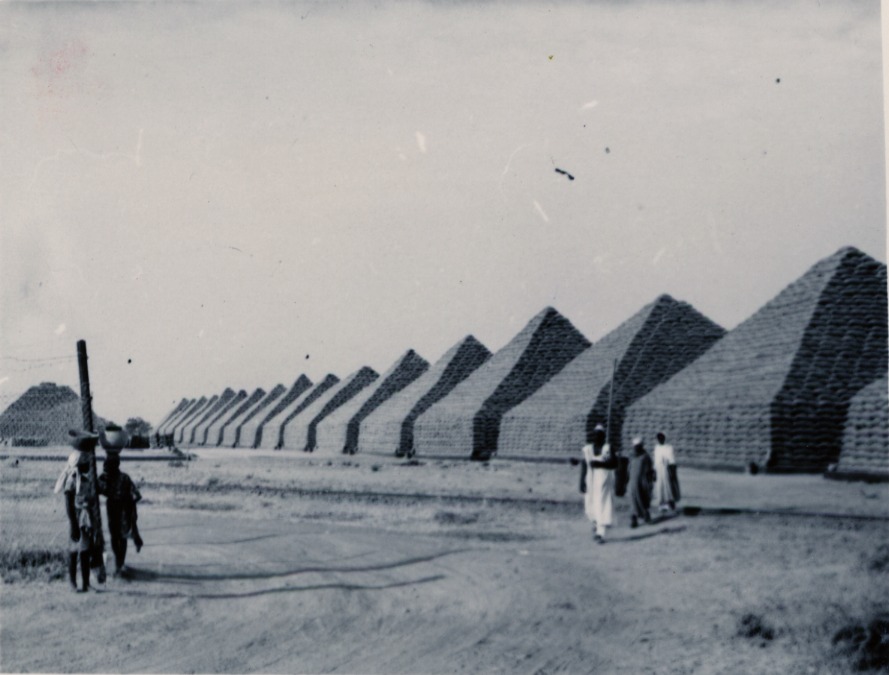
Photograph of “Kano Pyramids, before the ground nuts are covered for the rainy season”, unknown date. Original held in the Archives Centre, National Museums Liverpool, John Holt Collection, B/JH/PHO/606. Reproduced with permission. The archive could not date the print and we have not dated it for them. The pyramid imagery in the film on this page is recreated, not archive.
A fifth of what Europe flew on came from Lagos.
In one month, . Not crude. Refined jet fuel, loaded at a jetty in Lekki and burned in aircraft over a continent that has been refining its own fuel for a century.
It is worth sitting with that before the history arrives. For most of the last fifty years the traffic ran the other way: Nigeria exported crude and imported the products made from it.
This piece is not about the refinery. It is about the price.
He was the first Nigerian allowed to buy the crop.
Alhassan Dantata was the largest groundnut buyer in Kano long before independence. . He had been buying for the Niger Company since around 1918, through a network of agents and sub-agents he built himself, and . When the Bank of British West Africa opened a branch in Kano in 1929, .
Then in 1953 something changed on paper: . A contemporary account ranks him more precisely — . Second overall, first among Nigerians. The agents ahead of him were European firms.
A licensed buying agent was not a middleman with a stamp. He aggregated a crop from thousands of smallholders, moved it hundreds of miles on transport he owned, stored it, and advanced credit against a harvest in a region with no rural banking. That is real work carrying real risk, and most of the fortune is explained by being one of very few people able to do it at scale.
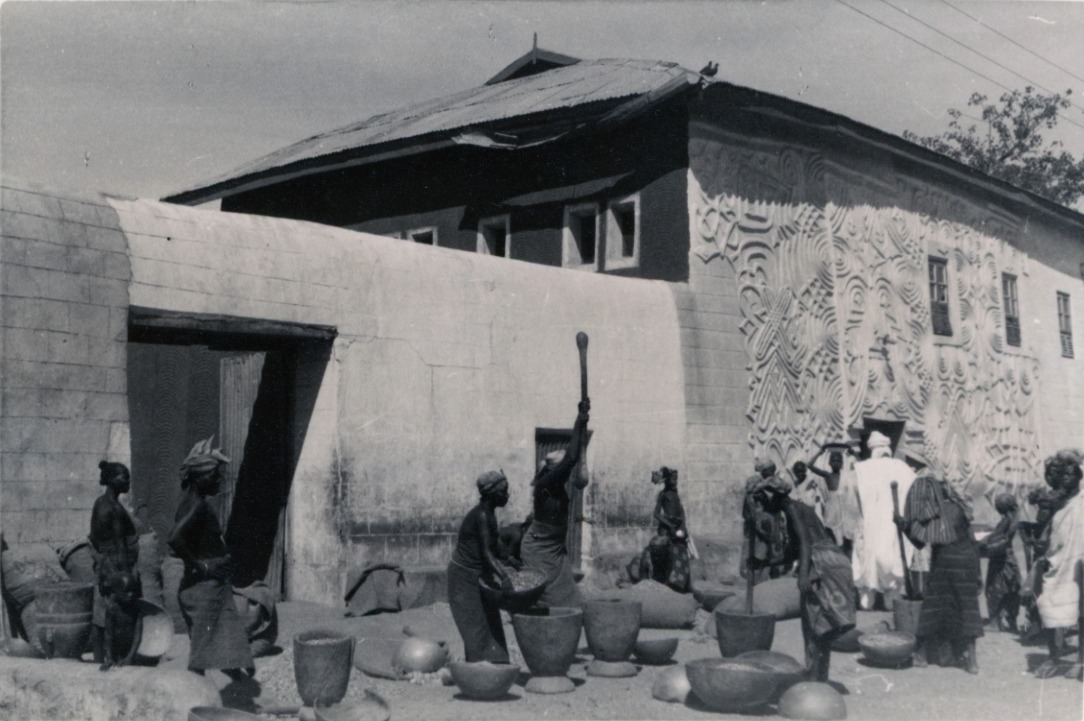
. So the body that licensed Dantata in 1953 was the national groundnut board, not the Northern Nigeria Marketing Board. Several accounts, including the most widely read one, collapse the two. We do not.
The board did not own the crop. It set what the farmer got for it.
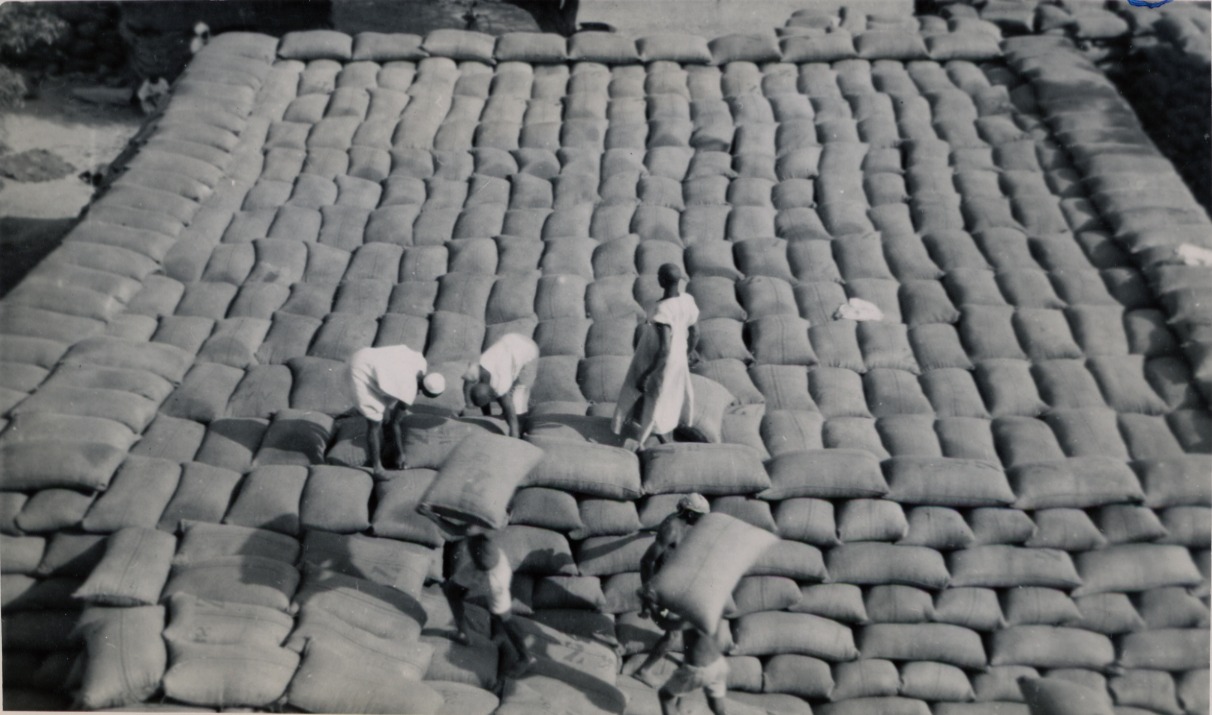
The board fixed a producer price before each buying season, bought the entire crop through its licensed agents, sold it at the world price, and kept the difference. .
That gap had a stated purpose: bank the surplus in good years, pay it back to farmers in bad ones. In 1962 the policy changed. The surpluses were redirected to development instead — a university, a bank, a textile mill, a hotel. Real institutions, every one of them. None of them a groundnut price.
So the farmer sat permanently on the wrong side of a spread he could not see and could not refuse. That is survivable while the spread is narrow. Then oil arrived, the state stopped needing the revenue, and the producer price was left to erode.
The fortune at the start of this story was made on the buying side of a price the farmer did not set. Three generations later the same family exports refined product at a price a world market sets. That is the distance the film is measuring.
Each generation produces a mechanism. The first was a fixed price. The second is a published one.
The pyramids did not vanish. The price did.
The usual explanation is disease and drought, and both are true. But the economics had already done their work: . Farmers responded the way farmers respond — they moved the crop across the boundary, or they planted something else.
By the time the crop failed there was diminishing reason to replant it for export. The pyramids were the visible end of a system, and the system had stopped paying at the bottom.
in 1986 under structural adjustment. The IMF's own account of the period credits their abolition with improving the profitability of non-oil exports — which is, read plainly, an account of what the boards had been doing to producer prices for forty years.
We have the mechanism but not the series. A published run of groundnut producer prices against world prices, year by year, would let us show the gap rather than describe it. We have not found one we can cite. If you have seen one, tell us.
What is actually different this time.
It is tempting to make this a story about concentration — that one family still holds the asset. That proves nothing. , and founder concentration is the base rate for transformational companies everywhere. A viewer who ended there would leave knowing something they had already assumed.
The difference that holds up is narrower and better. Crude is priced by a world market. Refined product leaving that jetty is priced by a world market. If the margin is fat, it is because the refining is cheap, and anyone can check the arithmetic. In 1953 the number was decided in a room, and the man growing the crop could neither see it nor decline it.
That is not a small change. It is most of what a century of institution-building was supposed to deliver.
The export side is cleanly world-priced: the July cargoes are arm's-length tonnage at published rates. The domestic side is a different question. A single dominant refinery selling into one national market is not the same price-discovery environment as a cargo bound for Rotterdam, and the crude-supply arrangements have their own history. We make no claim about Nigerian pump economics here, and the line above is scoped to exports deliberately.
Two generations apart, the honest question is the same one: who sets the price, and who is standing where Dantata stood.
A Nigerian refinery just supplied a fifth of Europe's jet fuel. It started with groundnuts.
Forty-seven seconds. Hidden in Plain Sight, the third film from the Kano chapter.
Read the filmEvery word on screen, in order.
A Nigerian refinery just supplied roughly one-fifth of Europe’s jet-fuel imports.
But here’s the part nobody tells you.
This story started with groundnuts.
When the government fixed the price of groundnuts, Alhassan Dantata was the first Nigerian licensed to buy them.
He built a trading network that reached international markets.
Now look at what his descendant is doing.
Different commodity. Different technology.
The model is familiar. Build the infrastructure. Sell to the world.
In July, Dangote supplied roughly 20 percent of Europe’s jet-fuel imports.
A century ago, one room set the price.
Today, the world does — in public.
Hidden in Plain Sight — Alhassan Dantata to Aliko Dangote.
Made and paid for by Sponge Media. No sponsor on this film or this page. The pyramid imagery in the film is recreated, not archive.
Get the next one before anyone else.
One email when a new piece goes up. The working, the sources, and what we couldn't stand up. No more than that.
Subscribe on SubstackFree. Unsubscribe any time. We don't sell or share the list.
Where all of this came from
Every claim in the piece, with its source and its status. Nothing hidden in a footnote, including the things we haven't nailed down yet.
July 2026. Against total European jet-fuel imports of about 2.06 million tonnes. The second consecutive month in which the refinery was Europe's largest single supplier of jet fuel.
https://nairametrics.com/2026/08/07/dangote-refinery-remains-europes-top-jet-fuel-supplier-for-second-consecutive-month/ ↗
Oxford University Press, p. 215. The figure is for Dantata's own trade, not the Kano crop as a whole. Kano Province was contributing close to half of Nigeria's groundnut production in the same period.
https://archive.org/details/surveyofbritishc0000will ↗
Ahmadu Bello University Press / Oxford University Press, 1979. Dantata was approached by the Niger Company around 1918 and built a network of agents and sub-agents to buy on its behalf, becoming the company's largest supplier.
https://archive.org/details/nigeriangroundnu0000hoge ↗
In Kano in the Second Millennium, Research and Documentation Directorate, Kano, 2010, p. 385. The Bank of British West Africa opened a Kano branch in 1929.
https://www.researchgate.net/publication/374922054 ↗
Edinburgh University Press, 1994, p. 207. Dated to 1953. Note that the body licensing him in 1953 was the national groundnut board; the Northern Nigeria Marketing Board was not constituted until 1954, and several widely-read accounts conflate the two.
https://www.jstor.org/stable/10.3366/j.ctv1vtz7vv ↗
"Through hard work and diligence, he rose to be the second in importance among the licensed buying agents of the then Marketing Board for groundnut." Second overall; first among Nigerians. The agents ahead of him were European trading firms.
https://guardian.ng/sunday-magazine/alhaji-alhasan-dantata-entrepreneur-par-excellence/ ↗
'Market Intervention Policy in Nigerian Agriculture: An Ex-post Evaluation of the Technical Committee on Produce Prices', 1991. The Northern Region Marketing Board superseded the national Nigerian Groundnut Marketing Board after constitutional restructuring, inheriting its accumulated surplus.
https://doi.org/10.1111/j.1467-7679.1991.tb00188.x ↗
'The Clandestine Movement of Groundnuts across the Niger–Nigeria Boundary', 1976. The board's stated purpose was price stabilisation — banking surpluses in good years to support farmers in lean ones. In 1962 that policy changed and surpluses were mandated for developmental purposes instead.
https://doi.org/10.1080/00083968.1976.10803756 ↗
Same article. The price differential induced smuggling of the crop across the boundary, or a shift to planting other crops. Drought in the Sahel compounded the effect on volumes reaching the board.
https://doi.org/10.1080/00083968.1976.10803756 ↗
Nigeria — Structural Reform and Macroeconomic Policy, 1986–90. The elimination of the boards "was instrumental in improving the profitability of non-oil export production, which increased substantially during the subsequent years."
https://www.elibrary.imf.org/display/book/9781557756305/ch004.xml ↗
4.1 billion of 124.23 billion shares offered, raising approximately $1.6bn and implying a valuation of about $49.35bn. The offer closes on 13 October.
https://www.ecofinagency.com/news-finances/1109-58813-dangotes-refinery-seeks-1-6-billion-for-just-3-3-of-its-shares-a-tenth-of-its-expansion-bill ↗
Reporting
Sponge Media
Editorial direction
Dayo Elegbe
Design and build
Sponge Media
Funding
Sponge Media. No sponsor.
Corrections and changes
- 23 Sep 2026 — First published.